
News
Focusing on the company's major milestones, industry events, and authoritative perspectives. Listening to the voices of a benchmark enterprise in the chemical industry.
When do water treatment chemicals fail to control scaling effectively
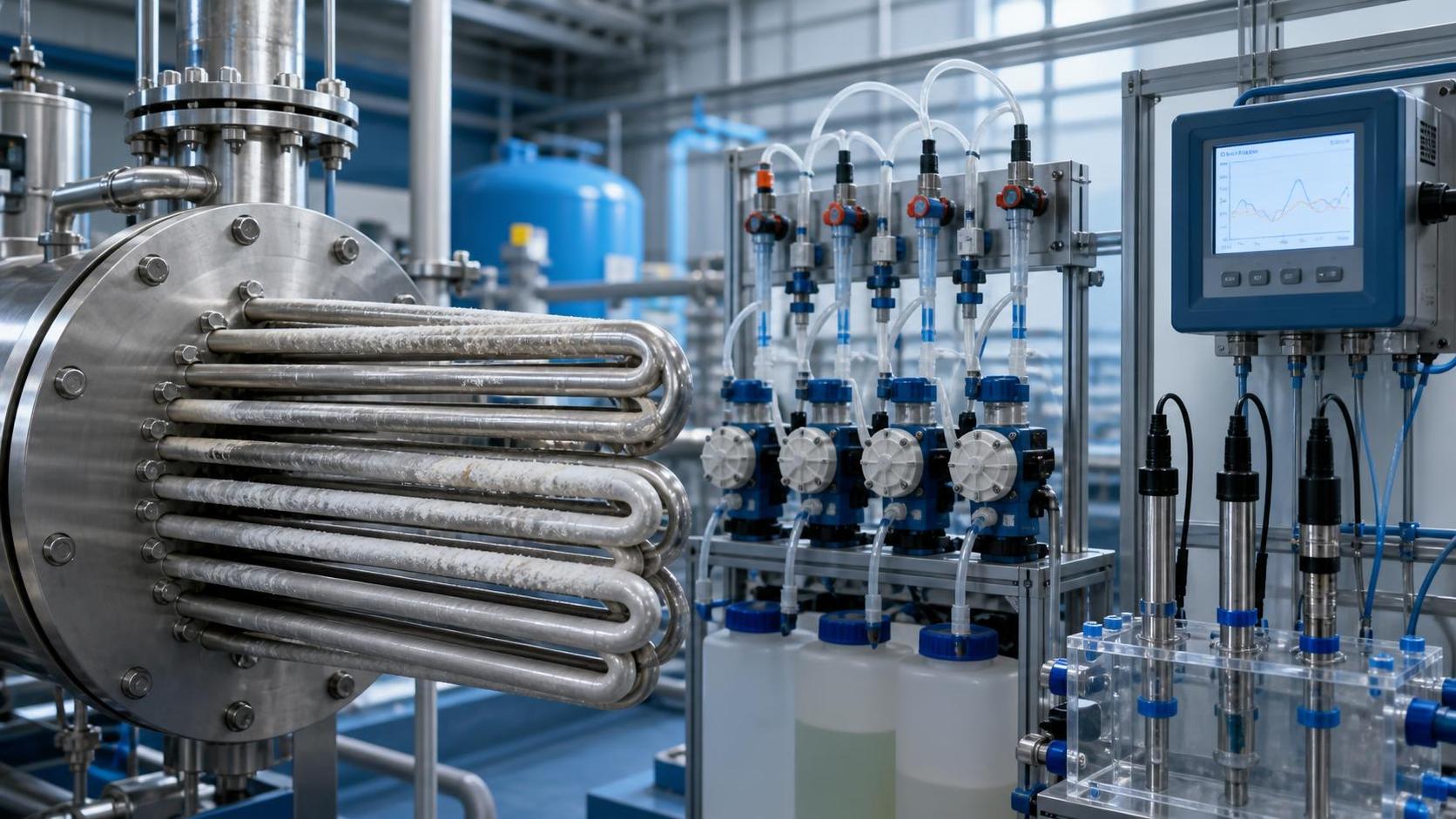
In many plants, scaling does not announce itself dramatically. It starts quietly: a heat exchanger loses efficiency, pressure drop inches upward, cleaning intervals become shorter, or a boiler seems to consume more energy than usual. Operators may already be feeding Water Treatment Chemicals, so the first reaction is often confusion. If the inhibitor is in the system, why is scale still forming?
The answer is usually not that scale control “stopped working” for no reason. More often, the chemistry is being pushed outside the conditions where it can perform well. Scale inhibitors, dispersants, threshold agents, and related treatment products are effective tools, but they are not magic barriers. Their success depends on water chemistry, operating stability, feed control, mechanical condition, and the match between the treatment program and the actual fouling risk.
For operators, this is an important distinction. When you understand when water treatment chemicals fail to control scaling effectively, troubleshooting becomes faster and more practical. Instead of adding more chemical and hoping for improvement, you can identify the real limit in the system.
Scale control fails when the water chemistry has changed but the treatment program has not
One of the most common reasons for poor performance is a shift in water composition. A treatment program may have worked well for months, then suddenly scale begins to appear after a change in source water, process leakage, pretreatment upset, or seasonal variation.
Scaling tendency is heavily influenced by calcium, magnesium, alkalinity, sulfate, silica, phosphate, iron, and pH. Even relatively small changes can alter saturation levels and make a once-stable treatment program inadequate. A cooling tower, for example, may run smoothly at one cycle of concentration, but when makeup water hardness rises or alkalinity increases, the same dosage no longer provides enough protection.
This is where operators can get trapped by routine. If the feed pump is still running and the tank is not empty, it feels like treatment is in place. But Water Treatment Chemicals are selected and dosed based on expected water conditions. When those conditions shift, the original program may no longer match the new scaling risk.
Warning signs include:
- Recent changes in raw water or makeup water source
- Higher conductivity or hardness without treatment adjustment
- Unexpected rise in pH or alkalinity
- More suspended solids or iron entering the system
- Shortened runtime before deposits appear
If scale appears after a water quality change, the problem may be chemistry fit, not product failure.
Low dosage is an obvious cause, but inconsistent dosage is often the bigger problem
Underdosing is easy to understand: too little inhibitor leaves crystal growth and deposition insufficiently controlled. What is less obvious is how often the issue is not average dosage, but unstable dosage.
Many systems do not operate under perfectly steady flow, temperature, and makeup demand. If chemical feed is tied to a signal that drifts, if a pump loses prime, if injection quills foul, or if the product day tank is not mixed properly, the treatment residual may swing throughout the day. During those low-residual periods, scale can begin forming on hot or high-stress surfaces. Once deposits gain a foothold, simply restoring dosage may not remove them.
Operators sometimes respond by increasing feed dramatically. That can help in some cases, but it can also create new issues, especially if the program includes phosphonate or polymer chemistry sensitive to system conditions. A large correction without understanding the root cause may waste chemical while leaving deposits untouched.
A more useful question is: was the chemical truly present at the right point, at the right concentration, at the right time?
High temperature can push a good inhibitor beyond its practical limit
Scale control becomes much harder on hot surfaces. This is why boilers, high-temperature closed loops, evaporative systems, and heat exchangers can develop tenacious deposits even when bulk water test results look acceptable.
Temperature changes several things at once. It can reduce the solubility of certain salts, accelerate precipitation, concentrate dissolved minerals at the heat-transfer surface, and stress the stability of some treatment components. Calcium carbonate scaling, for instance, often worsens where local temperature and pH conditions at the metal surface differ sharply from the bulk water.
In practical terms, this means a treatment program that works in a cool recirculating loop may struggle in a hotter zone of the same system. Operators sometimes rely on basin or sump measurements, yet the actual deposition event is happening on the tube wall, plate surface, or boiler metal interface.
If the process is operating at higher temperature than originally designed, or if heat flux has increased due to production changes, even well-chosen Water Treatment Chemicals may no longer be sufficient on their own. The system may need lower cycles, improved blowdown control, pretreatment upgrades, or a different inhibitor package designed for the new thermal load.
pH drift is one of the most underestimated reasons for poor scale control
Operators often focus on hardness and conductivity first, but pH can quietly reshape the entire scaling picture. A rise in pH encourages carbonate scale formation in many systems. In other cases, pH affects the performance of polymers, phosphonates, dispersants, or metal stabilizers that are part of the treatment program.
This becomes especially important when acid feed systems, caustic additions, alkalinity adjustments, or process contamination influence water balance. A cooling system with a pH controller that is slow to respond may spend enough time out of range for deposition to occur, even if daily logs appear normal. Looking only at one or two grab samples can hide these swings.
When scale appears unexpectedly, trend data matters more than isolated numbers. If pH has become unstable, the treatment chemical may not have failed in itself; the operating window has moved.
Pretreatment problems often show up later as “chemical failure”
When softeners leak hardness, reverse osmosis performance declines, filters channel, or suspended solids carry over, the downstream scale control program takes the blame. This is understandable. The deposits are visible in the main system, while the pretreatment issue may be easy to miss until it becomes severe.
But many Water Treatment Chemicals are designed to control a defined load, not compensate indefinitely for upstream breakdown. A softener that is not regenerating properly can suddenly allow calcium and magnesium to pass. A filter upset can bring in iron, silt, or corrosion debris that acts as nucleation sites for scale crystals. Once surfaces become rough or dirty, inhibitors have a harder job.
This is why deposit control should never be judged only by the chemical drum. Operators need to look upstream as well:
- Is hardness breakthrough occurring?
- Are pretreatment units being monitored with the right frequency?
- Has membrane rejection changed?
- Are solids entering from process leaks or corrosion products?
In many facilities, fixing pretreatment restores scale control more effectively than changing chemistry alone.
Some deposits are not purely scale, even if they look like scale at first glance
This is another reason troubleshooting can go off course. Not every hard deposit is a classic mineral scale, and mixed deposits are very common. What starts as a thin mineral layer may trap corrosion products, biological matter, clay, or process contaminants. Likewise, fouling from iron or silica may be misread as simple hardness scale.
Why does this matter? Because the right corrective action depends on the deposit type. A scale inhibitor formulated mainly for carbonate control may not manage silica-rich deposition well. A dispersant can help keep some particles suspended, but if the real issue is iron fouling from corrosion or a process leak, the treatment strategy must change.
For operators, this is a frustrating moment. The system is being treated, dosage may be in range, and yet deposits remain stubborn. In these cases, deposit analysis is not a luxury. It is often the fastest way to stop guessing.
Residence time and dead zones can defeat an otherwise sound treatment program
Water treatment chemistry assumes the product is distributed through the system. In reality, not every part of a system sees the same flow pattern. Low-flow branches, stagnant sections, oversized tanks, underused exchangers, and poorly mixed sumps can create pockets where dissolved solids concentrate or treatment residual drops.
Scale tends to favor these neglected spaces. Once formed, deposits can then spread the problem by disrupting flow and heat transfer elsewhere. Operators may keep measuring acceptable residual at the main sampling point while localized deposition continues in a dead leg or low-velocity zone.
This is one reason system hydraulics matter as much as chemistry. Poor circulation, blocked strainers, bypassed equipment, and uneven distribution can make good water treatment look ineffective.
Maintenance gaps change the chemistry more than people expect
There is also a human side to scale control. Many failures happen not because anyone ignored the system, but because routines became fragmented. A sensor went out of calibration. Blowdown valves started sticking. Sampling frequency dropped during a busy production period. A feed line accumulated deposits and injection gradually worsened. None of these issues feels dramatic on its own.
Together, they can erase the protective effect of a treatment program.
For plant personnel, this can be one of the hardest lessons: Water Treatment Chemicals do not replace operating discipline. They support it. When monitoring and maintenance loosen, chemical performance becomes less predictable, and scaling often shows up as the first visible symptom.
What operators should check before blaming the product
When scaling appears, a quick but structured review usually gives better answers than an immediate product change. Focus on the conditions around the event:
- Did water source, makeup quality, or process contamination change?
- Was chemical feed continuous and verifiable, not just scheduled?
- Did pH, temperature, conductivity, or cycles move outside normal range?
- Was there a recent pretreatment upset?
- Are deposits localized to hot spots, dead zones, or certain equipment?
- Has deposit composition been confirmed, or is it assumed?
- Are sensors, pumps, and control devices calibrated and functioning?
This kind of review helps separate four very different situations: wrong chemistry, wrong dosage, wrong operating window, or wrong diagnosis.
Improving scale control usually means adjusting the whole program, not just increasing feed
The most reliable scale prevention comes from alignment between chemistry and operation. That may involve selecting a treatment better suited to hardness, alkalinity, sulfate, silica, or temperature conditions. It may also mean improving pretreatment, tightening pH control, stabilizing dosage, reducing cycles of concentration, increasing blowdown, cleaning old deposits, or correcting low-flow areas.
In other words, when water treatment chemicals fail to control scaling effectively, the solution is rarely a single knob to turn. Chemical treatment works best as part of a managed system. The product matters, but so do feed accuracy, monitoring, deposit identification, and process awareness.
For operators, that is actually good news. Scale problems can feel stubborn, but they are usually traceable. If you look beyond the assumption that “the chemical stopped working,” the pattern becomes clearer. Most failures are really mismatches between the treatment program and the conditions inside the system. Once that mismatch is identified, scale control becomes far more predictable, and equipment performance usually follows.
Navigation
- How pharmaceutical raw materials are checked for GMP compliance
- What to check before switching suppliers of chemical raw materials
- Where inorganic chemicals still hold an advantage over organic options
- What affects the cost volatility of key organic intermediates
- When do water treatment chemicals fail to control scaling effectively
Send Us A Message